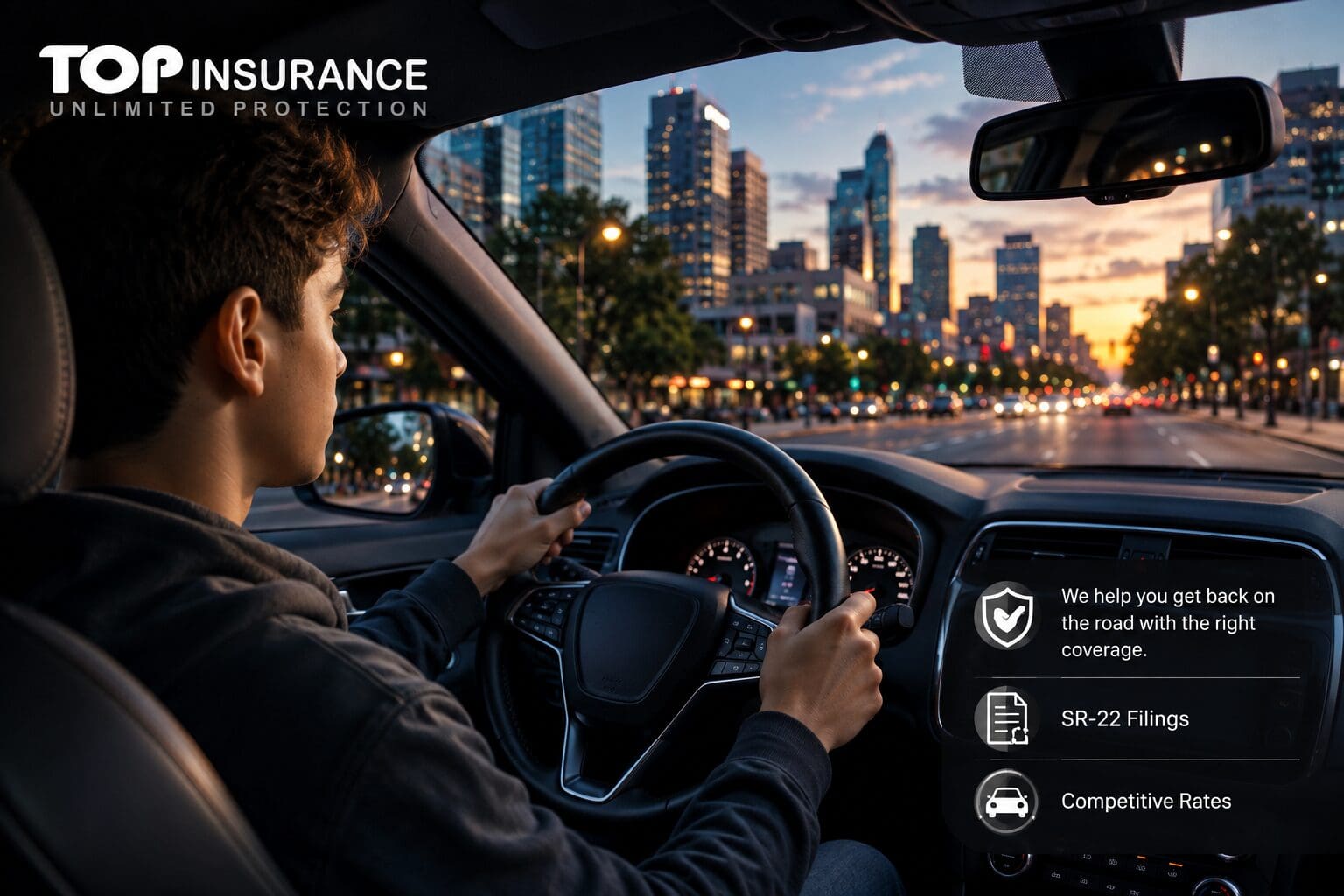
When should I add my teenager to my auto insurance policy?
Most insurers do not require you to add a teen while they only have a learner's permit, provided a licensed adult is in the vehicle. However, you must officially add them to your policy as soon as they receive their provisional or permanent driver's license. Failing to report a newly licensed household driver can lead to denied claims or policy cancellation.
- Insurance type
- Auto Insurance
- Languages
- Spanish and English
- Documentation
- Options available depending on carrier and eligibility
- Free quote
- Yes, no obligation
- Carriers
- Several compared
- Phone
- 1-877-579-0587
Fast, free quotes with bilingual agents. No obligation.
Adding a young driver—an adolescent who just got their license, a child returning home with a car, or a young family member who will share a vehicle—is an important step. Besides legal and safety considerations, the decision affects your premium, coverages, and liability in the event of an accident.
This guide explains, step by step, how to add a young driver to your auto insurance policy, what documents you’ll need, how to reduce the premium impact, which discounts to pursue, and common mistakes to avoid.
Important: Rules, requirements, and prices vary by state and insurer. Review your policy and consult a licensed agent at Top Insurance LLC for recommendations tailored to your state and situation.
Quick summary: Steps to add a young driver
-
Contact your agent or insurance company.
-
Gather the driver’s information: full name, date of birth, driver’s license number, license issue date, and relationship to the policyholder.
-
Provide vehicle details the young driver will use: VIN, primary use, where it is parked.
-
Review necessary coverages and limits.
-
Ask about discounts (good student, defensive driving, family bundle).
-
Adjust deductibles and coverage if appropriate.
-
Confirm enrollment and obtain updated proof of insurance.
When should you add the young driver?
-
If the young driver lives in your household and has a valid license.
-
If the young driver will regularly have access to the vehicle, even if they’re not the owner.
-
If the young driver owns a vehicle but lives with you (some insurers require inclusion on the household policy).
-
If the vehicle will be used regularly by the teen (commute to school, work, activities).
Failing to add a regularly using household driver when required can invalidate claims or be considered misrepresentation.
Information and documents the insurer will request
-
Full name and date of birth.
-
Driver’s license number or learner’s permit and issue date.
-
Driving history: tickets, accidents, suspensions (if any).
-
Residential address of the young driver.
-
Relationship to the policyholder.
-
Vehicle(s) the driver will use (VIN, year, make, model).
-
Primary vehicle use (commuting, school, work, leisure).
-
Education level (for good-student discounts) and marital status, if requested.
Having this information ready speeds up the process and reduces administrative errors.
How much will the premium increase when you add a young driver?
Adding a young, especially teenage, driver typically increases the premium significantly because statistics show higher risk. The impact depends on:
-
Driver’s age (16–19 are usually most expensive).
-
Driver’s driving record (tickets, accidents).
-
Vehicle type (sports cars and high-value models cost more).
-
Vehicle use and annual mileage.
-
Where the vehicle is parked (high-theft or high-accident ZIP codes raise rates).
-
Coverage levels and deductible choices.
Illustrative example (varies widely): adding a teen to a family policy can increase premiums anywhere from 30% to over 100% depending on variables. Get personalized quotes for precise numbers.
How to minimize the premium increase
-
Look for discounts:
-
Good student discount (often requires maintaining a minimum GPA).
-
Teen driver safety or defensive driving courses.
-
Family or multi-vehicle discounts (bundle).
-
Vehicles with safety features (airbags, ABS, anti-theft devices).
-
Pay-in-full or autopay discounts.
-
Telematics or usage-based insurance programs.
-
-
Choose a higher deductible if you can afford it.
-
Limit declared vehicle use or mileage if eligible.
-
Pick a safer, less expensive vehicle for the teen.
-
Enroll in telematics programs that reward safe driving.
-
Maintain a clean driving record for the teen; incentivize good behavior.
-
Shop multiple insurers for competitive rates.
Coverage options and considerations
-
Adding the young driver to your policy vs. the teen getting their own policy:
-
Adding to the household policy is usually cheaper if the teen lives at home and uses family vehicles.
-
In some cases (e.g., the teen works and has their own car), a separate policy may be preferable—compare costs.
-
-
Recommended coverages:
-
Liability insurance with adequate limits.
-
Collision and comprehensive if the vehicle is new or valuable.
-
Uninsured/Underinsured Motorist coverage as allowed by state law.
-
Medical Payments or PIP where applicable.
-
-
Consider higher limits if you have assets to protect.
Discounts specific to young drivers
-
Good student discount (requires proof of GPA or school record).
-
Certified teen driver safety course completion.
-
Telematics-based safe-driving discount.
-
Multi-policy bundle (homeowners/renters + auto).
-
Multi-vehicle discount.
-
Claim-free discounts.
Ask your insurer what documentation is required for each discount (report cards, course certificates, telematics summaries).
Common mistakes to avoid
-
Not disclosing that the teen lives in your home or uses the vehicle regularly.
-
Failing to add the teen once they have a license and access to the car.
-
Assuming the teen is automatically covered in all situations—policy terms vary.
-
Accepting the first quote without comparing other insurers.
-
Raising the deductible beyond acceptable limits considering your finances.
-
Missing available discounts.
Questions about learner’s permits
-
A learner’s permit often requires the teen to be supervised by a licensed adult driver; check if your insurer covers supervised driving during the permit period.
-
Some insurers handle permit status differently until the teen obtains a full license.
What happens if the young driver has a ticket or accident after being added?
-
Your insurer may raise your premium at renewal.
-
A claim can cause loss of discounts.
-
In severe cases, an insurer may impose conditions or, rarely, nonrenew or cancel according to policy terms and state law.
-
Maintain communication with your agent and review alternatives if issues arise.
Does adding the teen affect other drivers on the policy?
Yes. Adding a young driver may affect the policy’s overall premium and risk classification, which can change costs for all listed drivers.
Checklist before calling your insurer
-
Young driver’s full name and DOB.
-
License or permit number and issue date.
-
Driver’s residential address.
-
VIN and vehicle details the teen will drive.
-
Driving history of the teen (if any).
-
School transcript or proof for good-student discount.
-
Defensive driving certificate (if available).
-
Payment information and billing preferences.
Sample script to speak with your agent
“Hi, I want to add my child [Name] to my auto policy. They are [age] and got their license on [date]. They live at my address [address] and will primarily drive [year/make/model/VIN]. What additional details do you need, how will this affect my premium, and what discounts might apply?”
Use this script to save time and get precise answers.
Steps after adding the young driver
-
Request an updated declarations page and insurance ID cards.
-
Confirm the effective date of the coverage and any premium changes.
-
If the teen gets another vehicle or moves, notify the insurer immediately.
-
Review renewal options and shop around before accepting large increases.
Conclusion
Adding a young driver to your policy is an administrative step that impacts your finances and legal protection. Doing it correctly protects your family and avoids claim disputes. Understanding discounts, coverage choices, and how to keep premiums manageable will help you provide the right protection for your teen.
Get help adding a young driver with Top Insurance LLC:
-
Phone: (877) 579-0587
-
Get a quote: cotiza.topinsus.com
-
Auto Insurance: auto.topinsus.com
-
Website: www.topinsus.com
-
Service Areas: Georgia, Florida, Tennessee, Indiana, South Carolina, Alabama, Texas
This content is informational and not legal, financial, or insurance advice. Review your policy and consult a licensed agent for state-specific guidance.
Explore your coverage options
Frequently Asked Questions
When should I add my teenager to my auto insurance policy?
Most insurers do not require you to add a teen while they only have a learner's permit, provided a licensed adult is in the vehicle. However, you must officially add them to your policy as soon as they receive their provisional or permanent driver's license. Failing to report a newly licensed household driver can lead to denied claims or policy cancellation.
What information do I need to provide when adding a young driver?
You will need the driver's full legal name, date of birth, driver's license number, and the date the license was issued. You must also designate which vehicle on the policy they will primarily operate and provide the vehicle identification number (VIN) if adding a new car. Your insurer will use this information to update the policy's risk profile and adjust your premium.
Will adding a young driver increase my auto insurance premium?
Yes, adding an inexperienced driver generally increases your premium because statistical data shows higher accident risks for this age group. Your overall rate change will depend on factors such as the vehicle assigned, your coverage limits, and your state of residence. You can offset some of this increase by asking your agent about available discounts and adjusting your deductibles.
What discounts are available to help lower the cost of a young driver?
Common options include the good student discount for maintaining a specific grade point average and discounts for completing an approved defensive driving course. If the driver attends college at a distance without a car, you may also qualify for a student-away-at-school discount. Additionally, bundling your home and auto policies or maintaining a multi-car policy can help reduce the financial impact.
Should I adjust my liability coverage limits when adding a new driver?
With an inexperienced driver on your policy, your overall risk of an at-fault accident increases substantially. It is often wise to review and potentially raise your bodily injury liability and property damage liability limits to protect your household assets. Many families also choose to purchase a personal umbrella policy to provide an extra layer of liability protection beyond standard auto limits.

TOP Insurance LLC is a licensed independent insurance agency serving Georgia, Florida, South Carolina, Tennessee, Alabama, Indiana and Texas. Our bilingual team of licensed agents compares options from several carriers to find an alternative that fits your needs and budget. With offices in Duluth, Lawrenceville and Gainesville, GA, we specialize in auto, home, life, health and commercial insurance for the Hispanic community and all residents. Some carriers may offer options for applicants with an ITIN, consular ID, foreign passport or foreign license; required documentation and eligibility depend on each carrier.
Ready for your free quote?
Our bilingual agents help you compare options from multiple carriers to find an alternative that fits your needs and budget. Same-day response, no obligation.