Do I need a special permit for a food truck in Georgia?
Yes. Georgia has no statewide food truck permit, so you must obtain a mobile food service permit from the county health department in every county where you operate, and maintain an approved base of operation (commissary).
- Insurance type
- General Liability
- Languages
- Spanish and English
- Documentation
- Options available depending on carrier and eligibility
- Free quote
- Yes, no obligation
- Carriers
- Several compared
- Phone
- 1-877-579-0587
Fast, free quotes with bilingual agents. No obligation.
For food truck owners in Georgia, insurance has to cover two businesses at once — a restaurant and a vehicle. A single policy rarely does it: you need general liability for foodborne-illness and customer claims, commercial auto for the truck itself, and property coverage for the equipment you cook with. Getting that mix right is what keeps a fire, a fender-bender, or a bad batch from shutting you down.
Quick Answer: Food Truck Insurance in Georgia (2026)
- Georgia has no statewide food truck permit — you need a mobile food service permit from the county health department in every county where you operate, plus an approved base of operation (commissary).
- You need both general liability and commercial auto — the truck is a vehicle and a kitchen, and each needs its own coverage.
- Products-completed operations under general liability covers foodborne-illness claims.
- Equipment breakdown and food spoilage coverage protect your grills, refrigeration, and inventory.
- Workers comp is required in Georgia with 3 or more employees (O.C.G.A. § 34-9-2).
What Insurance a Food Truck Needs in Georgia
A food truck faces restaurant risks and road risks together, so its program combines several policies. Most Georgia operators build around general liability (with products-completed operations), commercial auto, property/equipment breakdown, spoilage, and workers compensation — plus liquor liability if they serve alcohol at events.
| Policy | What it covers | Why a Food Truck needs it |
|---|---|---|
| General Liability (Products-Completed Ops) | Customer injury and foodborne-illness claims | Your core exposure — a bad batch can sicken many customers at once; events require it |
| Commercial Auto | Accidents while driving the truck to and from locations | The truck is a vehicle; a personal auto policy will not cover business use |
| Property & Equipment Breakdown | Grills, fryers, refrigeration, and generators | Cooking equipment is expensive and breaks down under heavy daily use |
| Food Spoilage | Inventory lost when refrigeration or power fails | A single failure can spoil a full truck of product |
| Workers Compensation | Medical bills and lost wages for injured staff | Required with 3+ employees; burns, cuts, and slips are common on a truck |
The Most Common Insurance Mistakes for Food Trucks in Georgia
Mistake #1: Relying on a personal auto policy for the truck
The moment you use the vehicle for business, a personal auto policy can deny the claim. A food truck needs commercial auto covering both the driving and the built-in equipment.
Mistake #2: Skipping products-completed operations coverage
Foodborne illness is a food truck’s signature claim, and it can affect many people at once. Products-completed operations under general liability is what responds — do not let it be excluded.
Mistake #3: Assuming one county permit covers the whole state
Georgia has no statewide preemption, so you need a permit from the health department in every county you serve, plus an approved commissary. Operating without them can void coverage and shut you down.
Mistake #4: Ignoring equipment breakdown and spoilage
If your refrigeration fails at an event, you lose both inventory and revenue. General liability does not pay for that — equipment breakdown and spoilage coverage do.
Mistake #5: Forgetting liquor liability at events
If you serve or sell alcohol at festivals, a liquor-related claim is excluded by standard general liability. Add liquor liability before the event, not after.
Food Truck Risks in Georgia
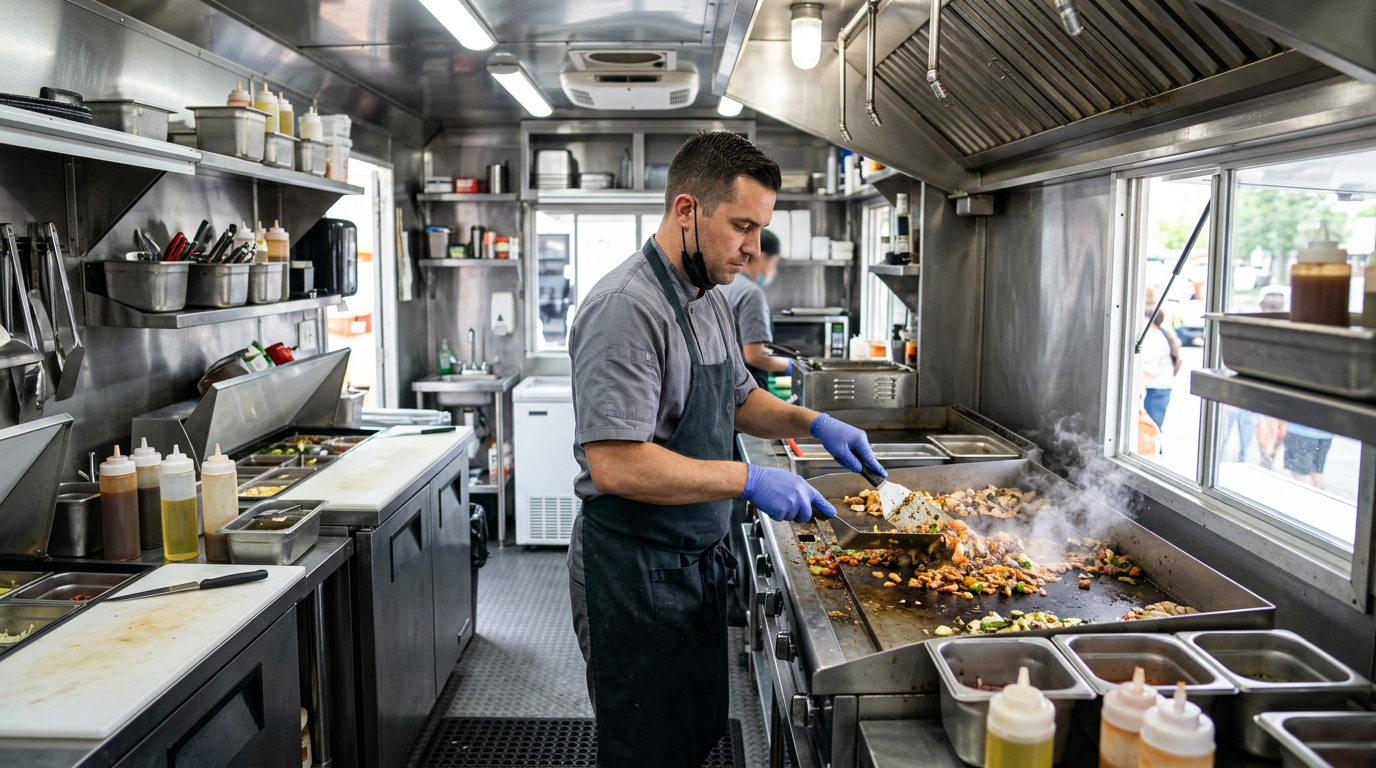
Georgia food trucks cook with open flame and hot oil in a small space, drive between events across multiple counties, and serve the public directly. The defining exposures are cooking fires, auto accidents, equipment breakdown, and foodborne illness — which is why a food truck program has to blend restaurant coverage and commercial auto rather than relying on either one alone.
How to Save on Food Truck Insurance in Georgia
- Install and maintain a UL 300 fire suppression system — it lowers property risk and premiums.
- Bundle general liability, commercial auto, and property with one carrier for a package discount.
- Keep your food-safety certification (CFPM) and health permits current for better pricing.
- Document a preventive maintenance schedule for cooking and refrigeration equipment.
- Match limits to your event contracts — many venues require specific liability amounts.
Why Choose TOP Insurance in Georgia
TOP Insurance has helped over 10,000 families and business owners across Georgia, Florida, Texas, South Carolina, Tennessee, Alabama, and Indiana find coverage options that fit their needs and budget. Our licensed, bilingual agents compare quotes from several carriers, so you never have to shop one company at a time.
Because we are an independent agency, we work for you, not the insurance company. We explain your general liability options in plain English or Spanish, help you avoid the common mistakes below, and stay with you at claim time. Visit us at one of our three Georgia offices in Duluth, Lawrenceville, or Gainesville, or get a free quote by phone.
Informational note
This guide is provided for general educational purposes and reflects rules and figures known as of 2026. Insurance laws and carrier programs change — for advice specific to your situation, speak with a licensed TOP Insurance agent.
Frequently Asked Questions
Do I need a special permit for a food truck in Georgia?
Yes. Georgia has no statewide food truck permit, so you must obtain a mobile food service permit from the county health department in every county where you operate, and maintain an approved base of operation (commissary).
Does my personal auto insurance cover my food truck?
No. A food truck is used for business, so it needs a commercial auto policy. A personal policy will typically deny a claim once it learns the vehicle is used commercially.
What covers a customer getting sick from my food?
Products-completed operations coverage under your general liability policy responds to foodborne-illness claims. Make sure it is included and not excluded.
Do I need workers comp for my food truck staff?
In Georgia, workers compensation is required once you have 3 or more employees under O.C.G.A. § 34-9-2. Burns, cuts, and slips are common in a food truck.
Get a Free Georgia Quote Today
Ready to protect what matters most? Our bilingual team makes it easy. Request your free, no-obligation quote and let a licensed agent compare your options in minutes. Explore our coverage options, learn more about insurance in Georgia, Florida, and Texas, or contact us today. Call 1-877-579-0587 or message us on WhatsApp at 1-470-429-0756.

TOP Insurance LLC is a licensed independent insurance agency serving Georgia, Florida, South Carolina, Tennessee, Alabama, Indiana and Texas. Our bilingual team of licensed agents compares options from several carriers to find an alternative that fits your needs and budget. With offices in Duluth, Lawrenceville and Gainesville, GA, we specialize in auto, home, life, health and commercial insurance for the Hispanic community and all residents. Some carriers may offer options for applicants with an ITIN, consular ID, foreign passport or foreign license; required documentation and eligibility depend on each carrier.
Ready for your free quote?
Our bilingual agents help you compare options from multiple carriers to find an alternative that fits your needs and budget. Same-day response, no obligation.