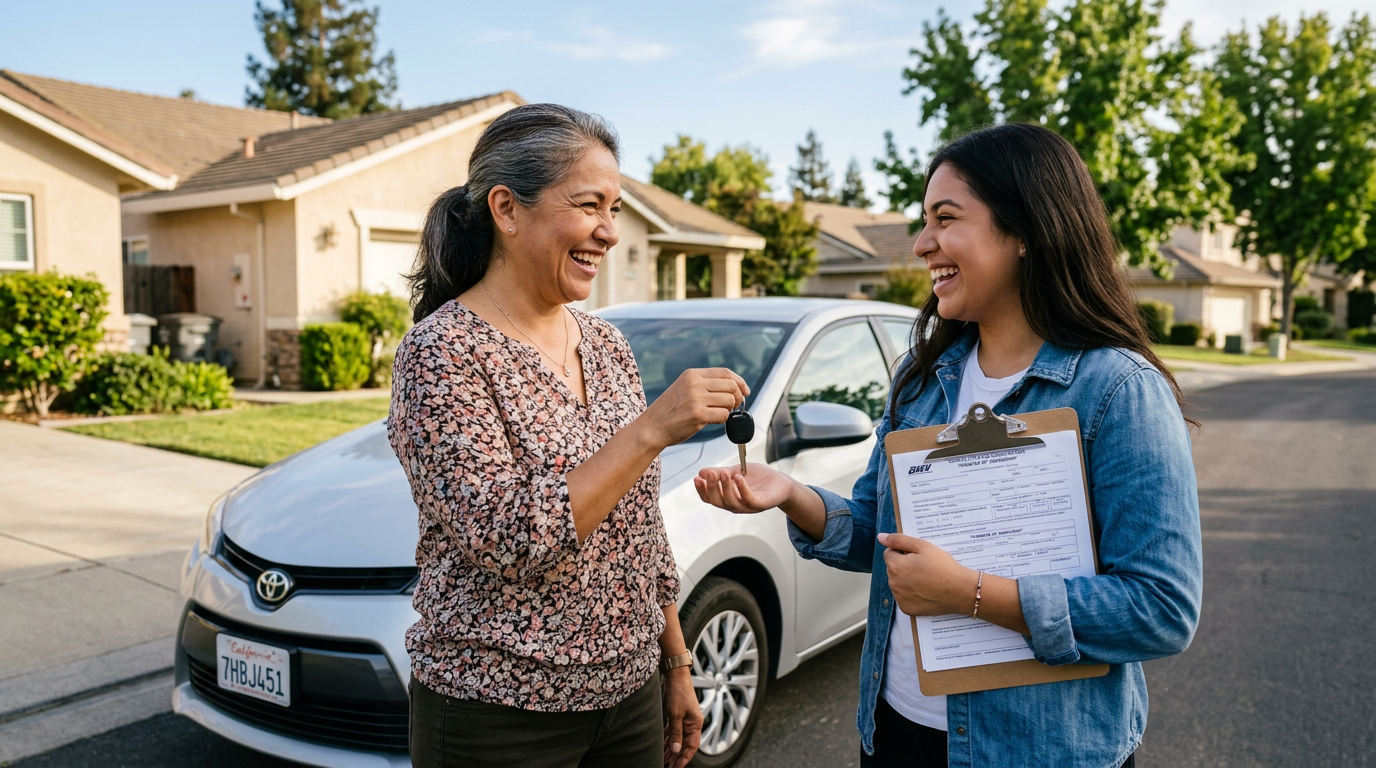
Can I transfer a car to my child without going to the DMV?
In most cases, no. Title transfer usually requires paperwork with the state DMV or MVD, plus the forms and documents that apply.
- Insurance type
- Auto Insurance
- Languages
- Spanish and English
- Documentation
- Options available depending on carrier and eligibility
- Free quote
- Yes, no obligation
- Carriers
- Several compared
- Phone
- 1-877-579-0587
Fast, free quotes with bilingual agents. No obligation.
Transferring a car to a family member in the United States may seem simple, but in practice it requires following specific legal and administrative steps. Every state has its own rules, forms, and deadlines, so the most important step is to confirm everything with the local DMV or MVD before completing the transfer. Even when the car stays in the family, the process is still formal: the title must be updated, the odometer must be disclosed when required, the vehicle must be registered in the new owner's name, and insurance must be active before anyone drives it.
At TOP Insurance LLC, we help Spanish-speaking drivers in Georgia and several states with several insurance carriers, three offices in Georgia in Duluth, Lawrenceville, and Gainesville, and bilingual service. When a family transfers a car, auto insurance is a key part of the process: the person giving up the vehicle must remove it from their policy, and the new owner must have active coverage in their own name before driving.
1. Check your state rules before you begin
The first step is to review the rules in the state where the transfer will happen. Even if the goal is the same, the forms, requirements, and exemptions can change a lot from one state to another. Some states use the DMV, while others use the MVD or another vehicle agency. The documents required when a car is gifted to a close relative can also vary.
- Confirm which agency handles titles and registrations in your state.
- Check whether family transfers require a special form.
- Ask whether your county requires an emissions or safety inspection.
- See whether a sales tax exemption exists for certain close relatives.
If the car will be driven on public roads, the new owner must have active insurance before driving. In a family transfer, this step is just as important as signing the title.
2. Review the vehicle title and the assignment section
Property transfer is normally completed at the state DMV or MVD using the vehicle title. The person giving the car away must sign the title's assignment of ownership section. That document is the legal foundation of the transfer.
Before signing, make sure the title is readable and that the names match official records. If there is an error, crossing out, or mismatch in the information, the DMV may request corrections or additional documentation. Do not sign in the wrong place or make changes unless the state form instructions allow it.
- Confirm the exact legal name of the seller or donor.
- Check that the VIN matches the vehicle.
- Enter the transfer date as the title instructs.
- Sign only where required and according to state rules.
3. Complete the odometer disclosure when required
Odometer disclosure is required by federal law for certain vehicles under a specific age. In practice, this means the mileage must be stated correctly when the vehicle is transferred, unless an exception applies because of the car's age or another federal or state rule.
This step helps prevent fraud and protects both the family member giving the car and the one receiving it. The odometer information usually appears on the title, on a state form, or on both. If the odometer is not working or the title requires a special certification, the DMV will explain how to proceed.
- Write the exact odometer reading at the time of transfer.
- Do not round or guess the number.
- If the title or form asks for an additional signature, complete it as instructed.
4. Prepare a bill of sale or gift statement
Many states require a bill of sale, even when the car is transferred within the family. If the vehicle is being gifted, some states also require a statement of gift or gift affidavit. This helps document that there was no traditional sale and explains the reason for the transfer.
The rules vary quite a bit from state to state. In some jurisdictions, a gift statement can support a possible sales tax exemption for certain relationships, such as spouses or parents and children. In others, the DMV may request additional forms or proof of the family relationship.
- Check whether your state requires a bill of sale even if no money changes hands.
- Ask whether a gift transfer needs a special affidavit.
- Keep copies of every signed document.
- If the car changes owners but stays in the family, document the relationship clearly.
5. Verify whether a sales tax exemption applies
Some states exempt certain transfers between close family members from sales tax, such as transfers between spouses or between parents and children. However, not every state uses the same family definition or the same forms. The result can also change depending on whether the vehicle is sold, gifted, or transferred as part of an estate.
For that reason, do not assume that every family transfer is tax exempt. The correct step is to verify with the local DMV which documents are required and whether the transfer qualifies for an exemption. If you do not meet the exact requirements, the transfer may be delayed.
6. Submit the application for a new title and registration
Once the documents are signed, the new owner must register the vehicle and obtain a new title in their name. This is usually done at the appropriate DMV or MVD, and it normally requires the signed title, identification, relationship documents if applicable, and the state registration forms.
If the vehicle will be used right away, it is best to complete this step as soon as possible. In some states, registration is not completed until active insurance, the required inspection, and any other local requirements are confirmed. The new title legally shows who the current owner is.
- Submit the title signed by the previous owner.
- Complete the state registration application.
- Attach gift statements or related forms if needed.
- Request the new title in the new owner's name.
7. Complete local inspections if required
In some counties or states, an emissions or safety inspection is required before the car can be registered. This depends on the location and the type of vehicle. Not every car needs the same inspection, and exemptions can vary based on age, county, or vehicle class.
The best approach is to confirm this requirement before going to the DMV so you can avoid a second trip. If inspection is required, bring the proof when you register. Without it, the registration may remain pending.
8. Activate the correct insurance before driving
This step is essential. Insurance must be active in the new owner's name before the vehicle is driven. Even when the transfer happens between family members, it is not a good idea to drive the car unless the policy has been updated. Likewise, the person giving the car away should remove it from their policy once the transfer is effective and they no longer own it.
This is especially important in Georgia and in other states where the rules about continuous coverage can be strict. If the car is uninsured or the policyholder name does not match the owner and primary driver, problems can arise with registration, driving, or claims.
- Activate a policy in the new owner's name before driving.
- Notify the insurer when the previous owner no longer has the vehicle.
- Confirm that the address and listed drivers are updated.
- Keep proof of insurance for the DMV if requested.
9. Consider the total cost of the transfer
DMV fees vary by state and sometimes by county. They can also change depending on the type of transfer, whether it is a gift, whether a duplicate title is needed, whether an inspection is required, or whether a new registration is issued. Because these amounts depend on the jurisdiction, it is always best to check with the local office before starting.
Also factor in auto insurance, because the new owner must keep active coverage to drive legally and with proper financial protection. At TOP Insurance LLC, we help compare options with several insurance carriers so families can find a solution that fits the vehicle's new use.
Frequently asked questions
Can I transfer a car to my child without going to the DMV?
In most cases, no. Title transfer usually requires paperwork with the state DMV or MVD, plus the forms and documents that apply.
If the car is a gift, do I still need documents?
Yes. Many states require a bill of sale or a gift statement, even if no money is exchanged.
Does the previous owner's insurance automatically cover the new driver?
Not necessarily. The new owner should have their own active policy before driving, and the previous owner should remove the vehicle from their coverage when appropriate.
Do all states charge sales tax on family transfers?
No. Some states exempt certain transfers between close relatives, but the rules vary by state and the local DMV must verify the forms.
Do I need an inspection before registering the car?
It depends on the state and county. In some places, an emissions or safety inspection is required before registration.
Transferring a car between family members is much easier when you follow the correct steps from the start: title, odometer, gift or sale documents, registration, inspections, and active insurance. If you confirm local rules and set up coverage before driving, the transfer will be much safer and less likely to face delays.
Related articles
- Auto insurance in Spanish
- Transferring car insurance between states
- Temporary car insurance in Georgia
Talk to a bilingual TOP Insurance agent
Before you transfer, buy or sell a car, make sure the right coverage is active. Our bilingual team compares options from several carriers to find the right protection at a fair price. Call 1-877-579-0587 or learn more about our auto insurance.

TOP Insurance LLC is a licensed independent insurance agency serving Georgia, Florida, South Carolina, Tennessee, Alabama, Indiana and Texas. Our bilingual team of licensed agents compares options from several carriers to find an alternative that fits your needs and budget. With offices in Duluth, Lawrenceville and Gainesville, GA, we specialize in auto, home, life, health and commercial insurance for the Hispanic community and all residents. Some carriers may offer options for applicants with an ITIN, consular ID, foreign passport or foreign license; required documentation and eligibility depend on each carrier.
Ready for your free quote?
Our bilingual agents help you compare options from multiple carriers to find an alternative that fits your needs and budget. Same-day response, no obligation.